
AI is reshaping how creative professionals work, from speeding up tedious tasks to expanding the range of ideas teams can explore. This article draws on insights from industry experts to show how AI tools are eliminating bottlenecks, improving decision-making, and allowing creators to focus on strategy rather than execution. Whether you're a solo creator or part of a larger team, these changes are already transforming creative workflows across industries.
Key Takeaways
- Automation removes tedious tasks: Manual work like retouching, resizing, formatting, and proofreading can now be handled by AI systems.
- AI compresses production time: Tasks like editing, drafting, and asset preparation now take minutes instead of hours.
- Creative work is shifting from execution to decision-making: Instead of producing assets manually, teams increasingly guide, evaluate, and refine AI-generated options.
- Early experimentation is becoming cheaper and faster: AI allows teams to generate and test many creative directions before committing resources to production.
- Creative professionals are focusing more on strategy and storytelling: With production friction reduced, teams can spend more time on brand voice, positioning, and narrative impact.
- Smaller teams can produce more work: Solo creators and small teams can now orchestrate workflows that previously required multiple specialists.
1. AI improves quality control and asset production
Upscale images and avoid rework
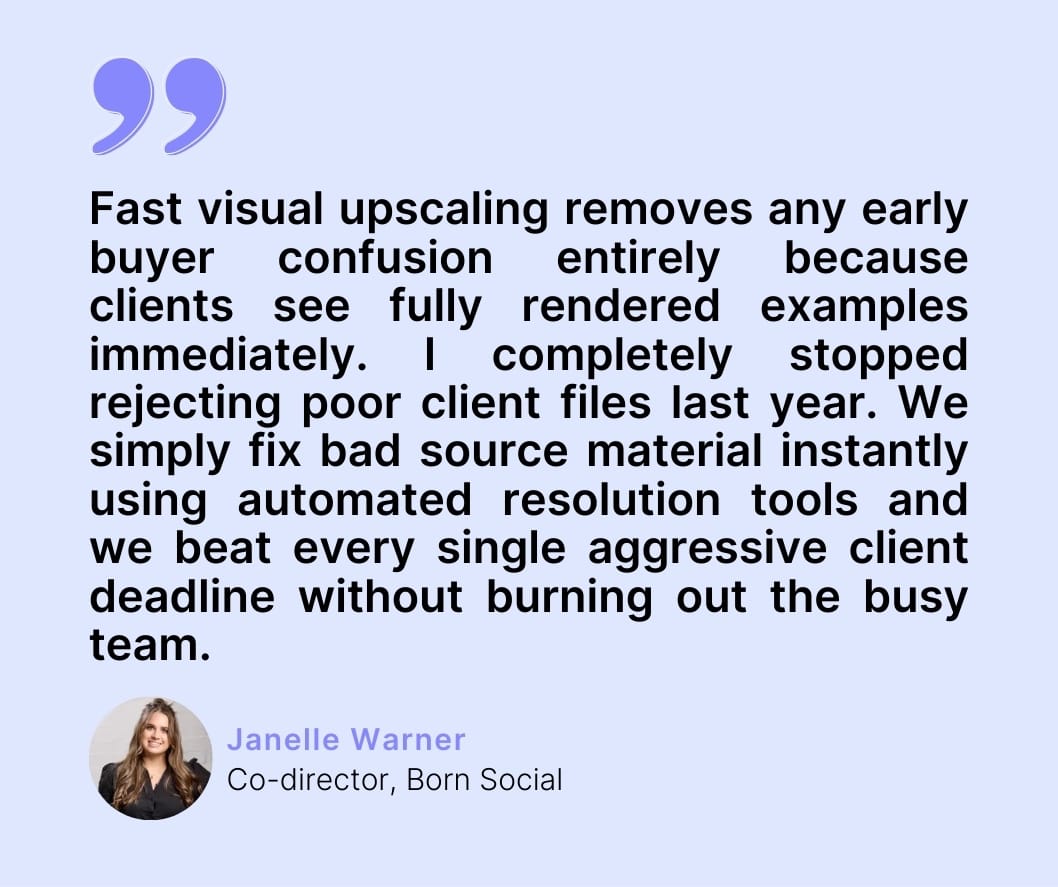
Poor product images kill online sales quickly. Many executives call automated tools displacement of human photographers, but I reject that fear. In my work running our agency, we are using machine learning to do upscaling of images in particular.
Our team completely skips the painful manual retouching phases during the initial drafting process. We just feed the software with low resolution client files and it produces print ready assets instantly. Staff members have high energy levels because they aren't doing exhausting pixel correction work.
You maintain your profit margins because you no longer wasting away endless hours sharpening blurry catalog photos by hand. I saw instant approval jumps since showing highly detailed computer mockups during our first meetings with a client on a project rather than asking the buyer to envision the finished product. We save forty hours each and every single week because the software takes care of the boring mathematical scaling and our staff is free to work on final artistic direction only.
Janelle Warner, Co-director, Born Social
Automate enhancement for consistent quality
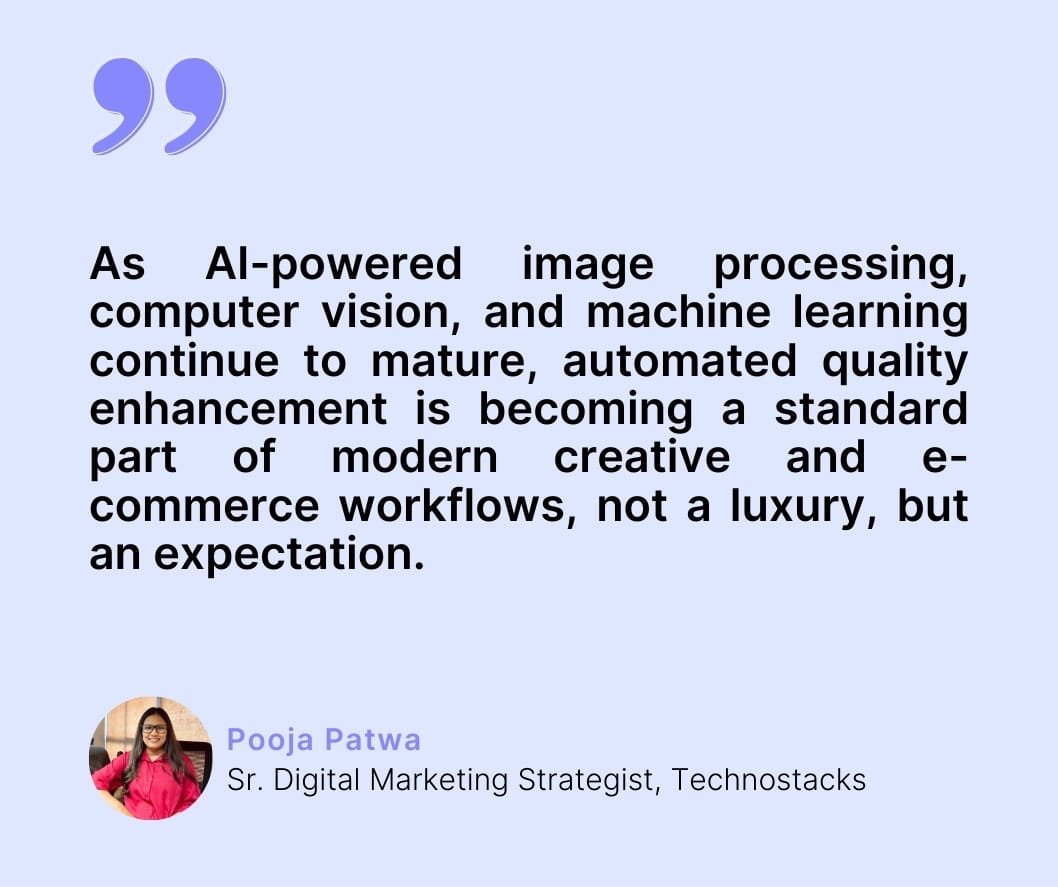
One of the most impactful ways AI is transforming creative workflows is through automated image enhancement and upscaling, cutting down hours of manual editing into a matter of seconds.
Traditionally, photographers, designers, and eCommerce teams had to manually retouch low-resolution images, fix exposure, reduce noise, and resize files for print or web. It was time-consuming, inconsistent, and technically demanding. AI has fundamentally changed that process.
Modern AI image enhancement tools can now automatically sharpen edges, recover fine detail, correct color, and upscale image resolution up to 512 megapixels, all without the over-processed, plastic look that comes from conventional filters. The AI reads what the image actually needs and adapts accordingly, whether it's a portrait, a product shot, an old scanned photo, or AI-generated artwork.
For teams managing large volumes of visual content, this is particularly significant. Bulk AI image processing allows entire product catalogs or photo libraries to be enhanced with consistent, print-ready quality, no reshooting, no repetitive manual work.
This shift isn't just about speed. It's about making professional-quality output accessible without requiring expert-level editing skills. Creative teams can now focus on storytelling and strategy, while AI handles the technical heavy lifting behind the scenes.
Pooja Patwa, Sr. Digital Marketing Strategist, Technostacks
2. AI compresses production and technical work
Compress production and accelerate prototypes
AI has fundamentally changed creative workflows, but not in the way many people assume.
It hasn't replaced creativity. It has compressed the production layer around it.
In practice, AI now handles the low-leverage stages: first drafts, research synthesis, headline variations, data clustering, basic design iterations, transcript analysis. That means teams spend less time staring at a blank page and more time refining positioning, narrative and commercial impact.
For us, the biggest shift has been speed to prototype. Campaign concepts, content frameworks and technical audits can be pressure-tested in minutes rather than hours. That accelerates iteration and improves decision quality.
But there's a boundary. AI is a force multiplier, not a strategist. It can generate options, but it cannot define brand nuance, judge cultural tone or make final commercial calls. Human oversight is still critical, particularly in areas like messaging hierarchy, risk management and brand alignment.
The net effect is leaner workflows and higher output velocity, provided there is discipline. Without clear quality control, AI can just as easily flood teams with mediocre volume.
Used correctly, it removes friction. It doesn't replace thinking.
Philip Young, CEO, Bird Digital Marketing Agency UK
Collapse steps to boost iteration
One of the most significant ways AI is changing creative workflows is by compressing the time between idea and execution.
Traditionally, a designer, writer, or filmmaker had to move through slow, sequential steps (brainstorming, drafting, revising, sourcing assets) often losing momentum between each phase. When used judiciously, AI tools collapse the tedious steps in the creative process. For example, a copywriter can generate 10 headline options in seconds, leaving more time for curating and refining rather than creating from scratch.
AI allows creatives to move into an editorial role, making judgment calls on AI-generated options rather than laboring over blank pages. This transforms what skills matter most: taste, critical thinking, and strategic direction become more valuable, while rote production tasks become less central.
The result is that creative teams can iterate more and experiment more freely, resulting in a better final product.
Jen McFarland, CEO, Women Conquer Business
Eliminate drudgery to enhance creativity
The biggest way that AI is going to dramatically change creative workflows is that it's going to allow artists and storytellers more quality time on the heart of their creative idea itself, while menial/boring tasks are resolved as efficiently as possible behind the curtain. There are smart tools for reducing the time it takes to get through rough cuts or color correction, sound clean-up and even early script breakdown in film & media.
AI is reducing the hours spent grinding away at drudgery, creating more time for the designer to play around with an idea, experiment and modify their vision. And that transformation in workflow drives efficiency and broadens the range of what can be achieved within the bounds of tight calendars and budgets.
Andrew Cussens, Digital Marketing Specialist| Founder & Producer, FilmFolk
3. AI is shifting the bottleneck from production to decision-making
Move bottlenecks toward better decisions
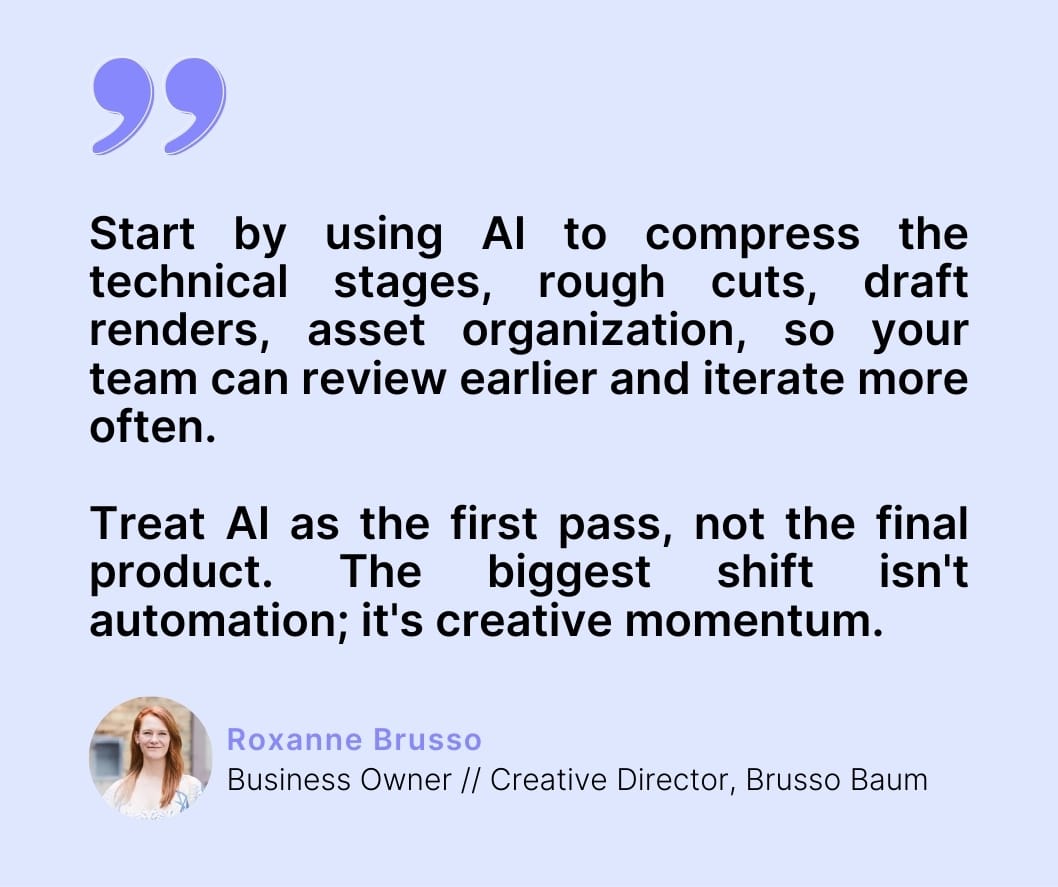
The first time I watched an AI tool generate a rough cut from hours of raw footage in minutes, I realized the creative bottleneck had quietly shifted. It's no longer execution that slows teams down, it's decision-making. In video and animation production, AI now handles the heavy lifting: auto-editing, color matching, background cleanup, even generating in-between frames. That frees creatives to spend their energy refining narrative beats and visual tone instead of wrestling timelines.
On a recent animation project, we used AI-assisted upscaling and scene interpolation to test three different stylistic directions in a single afternoon. What used to take days of rendering and manual adjustments became a rapid prototyping sprint. The result wasn't just faster turnaround; it was braver creative choices because the cost of experimentation dropped.
Roxanne Brusso, Business Owner // Creative Director, Brusso Baum
Shift effort from execution to guidance
One of the most meaningful ways AI is changing creative workflows is by shifting effort from execution to direction.
Traditionally, creative work required deep technical skill to move from idea to output. Editing, formatting, structuring, and production mechanics consumed the majority of time. AI is compressing that layer. It can now analyze raw material, extract structure, surface key themes, and suggest narrative arcs in seconds.
That shift allows creative professionals to focus more on intent, judgment, and strategic alignment rather than manual assembly.
In our work building AI-guided media systems for regulated industries, we've seen this clearly. AI can analyze uploaded video, identify usable moments, flag compliance risks, and propose an editorial direction before a human editor even begins. The human role doesn't disappear. It becomes more architectural. Instead of spending hours organizing content, the professional refines tone, ensures regulatory precision, and makes higher-level storytelling decisions.
Another impact is accessibility. AI lowers the barrier for subject-matter experts who aren't trained creatives. A clinician, engineer, or executive can now generate structured, production-ready direction without relying entirely on agencies. That expands who can participate in content creation while still maintaining governance and quality standards.
The key change isn't that AI creates instead of humans. It reorganizes the workflow. It accelerates analysis and production mechanics, so humans spend more time on clarity, ethics, brand, and impact.
That reallocation of cognitive energy is where the real transformation is happening.
Raul Reyeszumeta, VP, Product & Design, MarketScale
Speed drafts and prioritize choices
Without the use of AI, creativity flowed in one direction. Designers received briefs and produced creative options. The team reviewed the creative options together, and the cycle continued until the team approved a creative piece or asset. With the advent of AI, this process has completely changed. The traditional workflow of producing options for approval has now turned to the point where designers are completing the first draft in a couple of hours instead of weeks. We tracked production time across 12 active client campaigns over six months and found creative output moved roughly 60 percent faster from brief to final asset once AI handled the early stages of the workflow.
Although the quality of the final output remained constant, the entry point of human judgment into the process changed. Instead of spending time creating options, our production teams are now spending time making decisions about which creative options to move forward with. For small business owners with limited budgets and tight timelines, that change means the creative process is tested more quickly in the marketplace, receives feedback from consumers at a faster rate, and eliminates wasting money on untested and potentially rejected concepts.
David Toby, Managing Director | Digital Marketing Specialist, Pathfinder Marketing
4. AI makes experimentation faster and cheaper
Widen directions and sharpen selection
The biggest shift I have seen is in the concepting phase. Our designers used to spend days creating multiple visual directions for a client pitch. Now they use AI image generation to produce rough concepts in hours, which means the creative director can review ten directions instead of three before choosing which ones to develop fully.
This doesn't replace the designer. It replaces the part of the process that was always bottlenecked by manual labor. The designer still makes all the creative decisions, they just get to make more of them faster. What surprised us is that creative quality actually went up because people were no longer emotionally attached to the first idea they spent two days on. When generating concepts is cheap, you are more willing to throw away mediocre ones and push further.
Shantanu Pandey, Founder & CEO, Tenet
Pretest visuals to tighten approvals
AI reduced the cost of visual indecision, and that changed how we allocate production budgets.
In a Wi-Fi 7 launch cycle, we used AI mockups to test more than 30 visual directions before approving a single hero asset. In the past, we would lock one or two concepts early because every revision meant agency fees, studio time, and resizing work for retail. We used to catch issues after listings were already live.
This time, we dropped the visuals into real placements before approving anything. Marketplace tiles. Promo banners. Even a shelf strip mockup. One lighting setup looked premium on a big screen. When we shrank it to thumbnail size, the product nearly vanished. That alone justified the extra testing. Catching it before the shoot prevented a reshoot and saved weeks of revision.
Approval cycles tightened. Fewer revision rounds. Cleaner launches across channels.
AI expanded the testing window. It didn't reduce the cost of bad judgment.
Laviet Joaquin, Marketing Head, TP-Link Philippines
Shorten first pass to multiply options
Compressing the first draft phase is one of the biggest ways AI is transforming the creative processes. Activities which once required hours, such as brainstorming angles, outlining, rewriting, repackaging ideas to fit other formats or testing various creative directions, can now take far less time. At work, it translates to more time on the workable draft and less time from blank page to workable draft, and more time on the part that actually makes the content effective, judgment, positioning, clarity, and relevance.
But, it's not speed that is the real benefit. Before publishing, it is the possibility of trying a greater number of variations.
Boris Dzhingarov, CEO, ESBO ltd
Validate concepts with data faster
One major way AI is changing creative workflows is by compressing the idea-to-execution cycle. At Brandualist, what once took days of brainstorming, drafting, and iteration now begins with AI-assisted concept generation and rapid variation testing. This doesn't replace creativity, it accelerates it.
We use AI to generate multiple creative angles in minutes, then validate them against performance data before production. This allows our team to focus on refinement and strategy instead of starting from a blank page. In one campaign, early AI-assisted concept testing reduced production revisions by 40% and shortened launch timelines by a full week.
The real shift is speed with structure. AI turns creative development into a data-informed loop rather than a long, linear process.
Karina Tymchenko, CEO & Co-Founder, Brandualist Inc.
Generate variations instantly to unblock
By taking advantage of AI, individuals are now able to create 100 versions of one idea in under a second.
The introduction of AI helped to remove barriers between our idea and getting it into production.
This is an example of how you can save time: One of the partners that I work with has saved 12.5 hours a week, thanks to the elimination of manual tasks such as resizing banners or moving logos.
As a result, we have observed the time to complete projects decreasing by more than 35%. We believe this increase in project-speed is due to the fact that the creators are able to focus on their strategy and vision and not spend the majority of their time doing mundane tasks that require "pixel-editing."
Those who will combine fast/intelligent systems with human intuition will own the future.
Teresa Tran, Chief Operating Officer, LaGrande Marketing
5. AI expands scale and creative participation
Scale personalization without sacrifice
In the past, creating different versions of content for multiple audiences was time-consuming and often limited to a few segments. With AI, we can quickly generate tailored messages, visuals, or email variations for hundreds or even thousands of audience segments.
This allows our team to deliver content that actually speaks to each group's interests and needs, rather than using a one-size-fits-all approach. From experience, we've seen that even small tweaks, like adjusting headlines or visuals, can make a big difference in engagement and conversion.
AI also helps us track which personalized versions are performing best, so we can double down on what works and refine what doesn't.
Ilya Telegin, Head of Content & Editorial Strategy, improvado
Empower solo creators to orchestrate
Our workflow has changed dramatically using different tools to orchestrate creative outputs. It has given our team the power to drive bigger outcomes at a higher velocity. Where we used to have multiple players across different expertise, one designer can now work as a super power, driving research, content creation, user experience, and visual design. This creates more cohesion across the project with knowledge maintained through all tracks. Tasks we used to do manually, we now feed requirements, data, and strategic input to steer execution.
Doug Hughmanick, Head of Design | Founder, ANML
Hasten turnaround with directed tools
In my field, marketing teams are no longer spending their hours staring at blank pages but directing tools. Clients receive results as quickly as 4 weeks when using automated image tools for bypassing the slow drafting phase. This is sufficiently quick for promoting creative ideas without wasting manual labor.
Internal logs reveal that the speed of production grew by 42% since we stopped drawing every asset by hand.
Another point to be considered is that modern day teams function more as editors to perfect the machine outputs. Using these systems allows people to stay focused on the vision without doing the tedious work of pixels with the software. Anyone who believes in efficiency knows that having a human being wait five rounds to sketch a logo is too long.
I have also witnessed the change in how we deal with labor through the use of these tools.
Most agencies are concerned about the machines spoiling the human touch in art. In my work the opposite occurred because designers actually get more time to think about the brand message. We use the machine to do the bulk of the labor and we polish the final version ourselves.
Angeline Licerio, PR and Communication Officer, RizeUp Media
6. AI enhances insight and creative self-understanding
Flag inconsistencies to elevate judgment
Before AI came along, we used up a lot of our time doing mechanical and precision tasks. For example, ensuring that patient-facing page content was consistent with the clinical language in draft three and making sure tone was uniform across all 20 pages of the service line. This is important in healthcare as inconsistent messaging could cause a patient to lose trust before even scheduling their first visit with our clients.
In many ways, AI did things differently for us. We now use Jasper to find inconsistencies in voice, identify where we were drifting from our messaging and identify gaps before anything even went to a client. My team no longer had to comb through the drafts manually. Instead, they could make more strategic decisions based on problem areas that were flagged by AI. So, we saw a reduction in time spent on the production side while having an increase in time spent on the thought process.
We didn't only become faster at writing through AI. At the same time, we regained our ability to ask ourselves whether what we wrote actually worked.
Madison Kirksey, Creative Director | Air Force Veteran | Mandarin Chinese Linguist | Author, Direction.com
Mirror voice to deepen authenticity
AI is shifting creative workflows from invention to amplification.
Most creatives think AI is about generating ideas faster, but it's actually about discovering what's already true about your creative voice. I've been using AI systems in brand strategy for two years now, and the biggest shift isn't efficiency, it's recognition.
Here's what happens: AI doesn't replace your creative instincts. It mirrors them back at you. When I feed my brand frameworks into AI, it doesn't invent new strategies. It helps me see patterns in my own thinking I couldn't spot before. Took me a while to trust that process, honestly. Same with visual work, AI shows you what your aesthetic actually is, not what you think it should be.
The workflow change that I've specifically seen? Instead of starting with a blank canvas and hoping for inspiration, creatives now start with their authentic voice and use AI to explore variations that stay true to that core. It's like having a creative partner who never gets tired of iterating but never loses sight of what makes your work distinctly yours.
That's the real transformation, AI as mirror, not mask.
Gina Dunn, Founder and Brand Strategist, OG Solutions
