
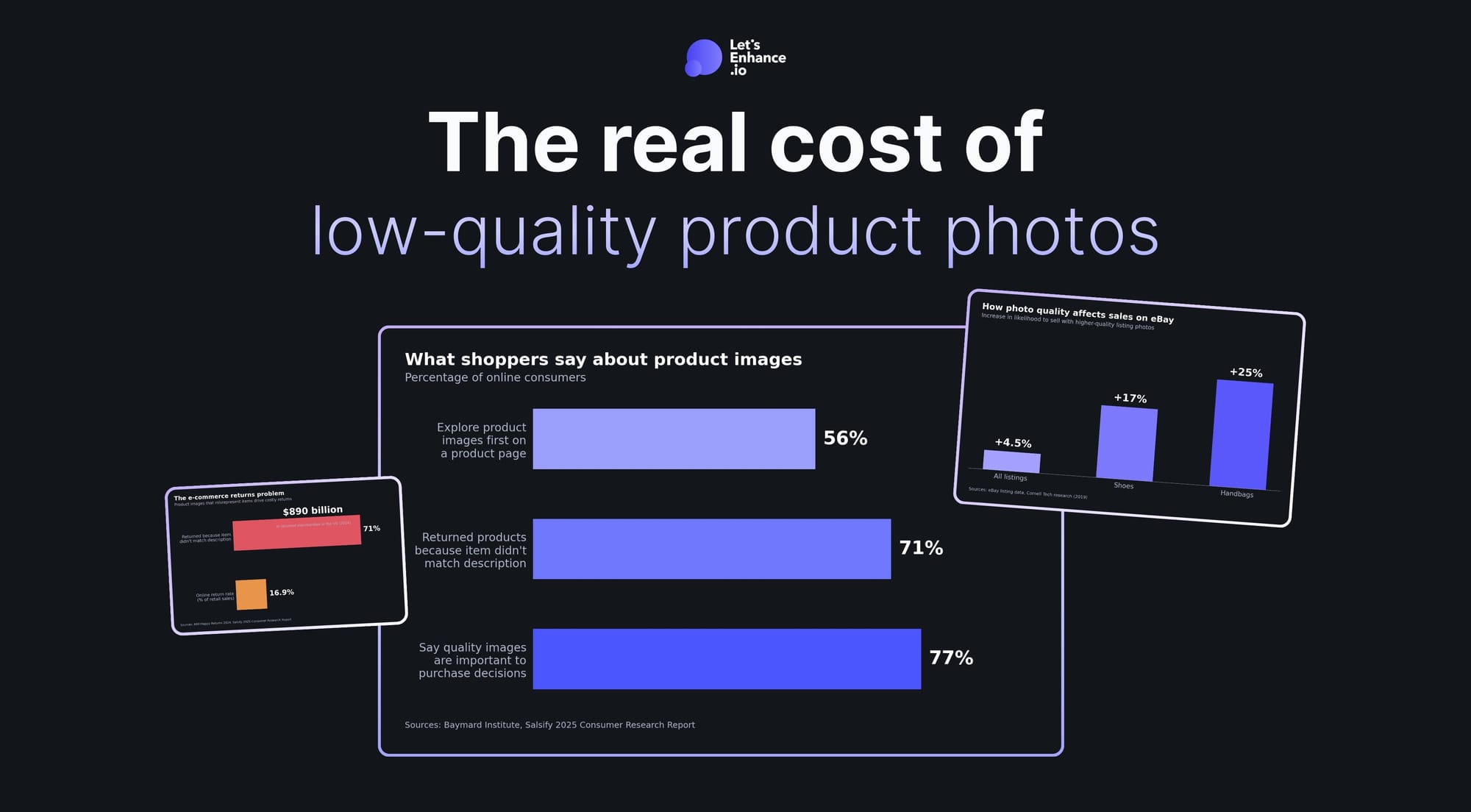
Online shoppers can't touch your product. They can't hold it, feel its texture, or check its build quality. The only thing standing between a browse and a buy is your product photo.
That's not a figure of speech. Research across academic studies and industry data consistently points to the same conclusion: product image quality is one of the strongest levers you have for conversion rates, return rates, and perceived product value. Here's what we know, and where the evidence comes from.
Your product photo is the first thing shoppers evaluate
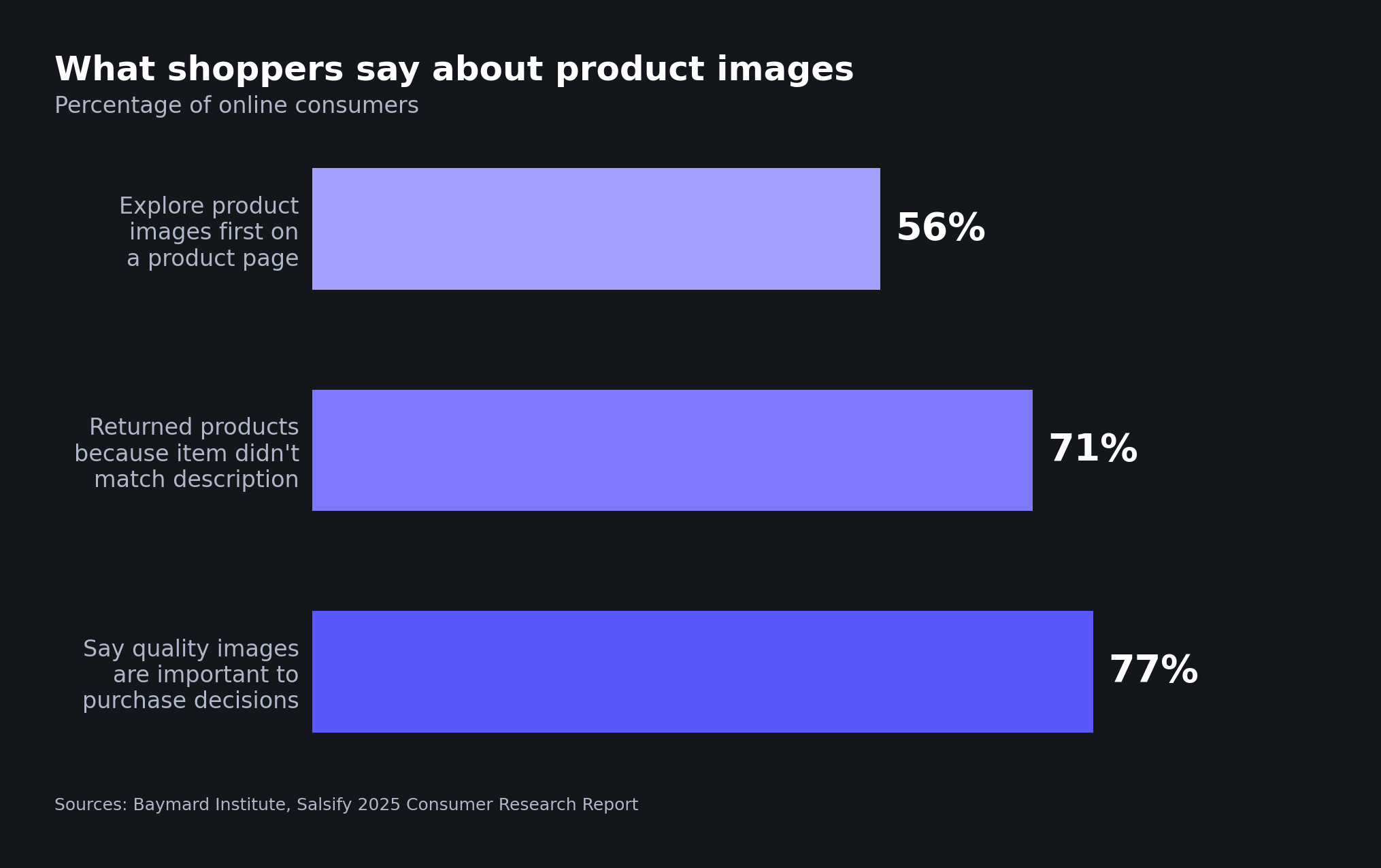
When someone lands on a product page, they don't start with the description. According to Baymard Institute's UX research, 56% of online shoppers' first action on a product page is to explore the product images, before reading titles, descriptions, or scrolling down.
This behavior isn't surprising. In a physical store, you'd pick the product up. Online, the image is the closest substitute. And the quality of that image shapes everything that follows: whether the shopper trusts the listing, how much they think the product is worth, and whether they click "add to cart."
Xia, Pan, Zhou, and Zhang (2020) studied how product photo elements in e-commerce search results affect click-through and sales. Using decision tree and regression models, they found that specific photo attributes (including logo placement, promotional overlays, and model presence) significantly influence whether a listing gets clicked and purchased. The product photo functions as the "hook" that determines whether a shopper engages further.
Clean backgrounds and sharp details sell more
The preference for clean, uncluttered product imagery shows up repeatedly in the data.
Szulc and Musielak (2022) surveyed consumers about product photography preferences and found that 68% prefer products photographed in clean, distraction-free settings (like a shadowless tent). Adding extra visual information, prices overlaid on the image, or busy lifestyle backgrounds actually reduced purchase appeal. Simpler was better.
This aligns with Meng, Kou, Duan, and Jiang's research (2022) in Psychology & Marketing, which examined how background sharpness affects product perception. A blurry background (the kind you get from a shallow depth of field) made consumers perceive products as physically larger, an effect mediated by how attention gets allocated between the product and its surroundings. Depending on the product category, that can help or hurt. For products where size signals value (a laptop, a handbag), the effect is positive. For products where compactness matters, it can backfire.
The takeaway isn't that every product photo needs a white background. It's that the background choice should be intentional, and the product itself should be the clear focal point. Clutter and visual noise hurt conversion.
Image quality shapes trust and willingness to pay
Product images don't just influence whether someone buys. They influence how much they're willing to pay.
Ert and Fleischer (2020) studied Airbnb listings and found that hosts who posted higher-quality, more attractive photos were perceived as more trustworthy and could charge higher prices. While this study focused on hospitality, the mechanism applies broadly: visual quality signals professionalism and reliability. A crisp, well-lit product photo tells the buyer, "This seller takes their business seriously."
The flip side is equally powerful. Low-quality images create uncertainty. Hong and Pavlou (2014), in a widely cited paper in Information Systems Research (362 citations), identified "product fit uncertainty" as a key barrier in online markets. When consumers can't fully evaluate a product's quality and fit from the images provided, they either don't buy or buy and return. More detailed, higher-quality product images reduce this uncertainty and increase conversion.
Industry data from Salsify's 2025 Consumer Research Report reinforces this: 77% of shoppers say high-quality images and videos are important to their purchase decisions.
Better images, fewer returns
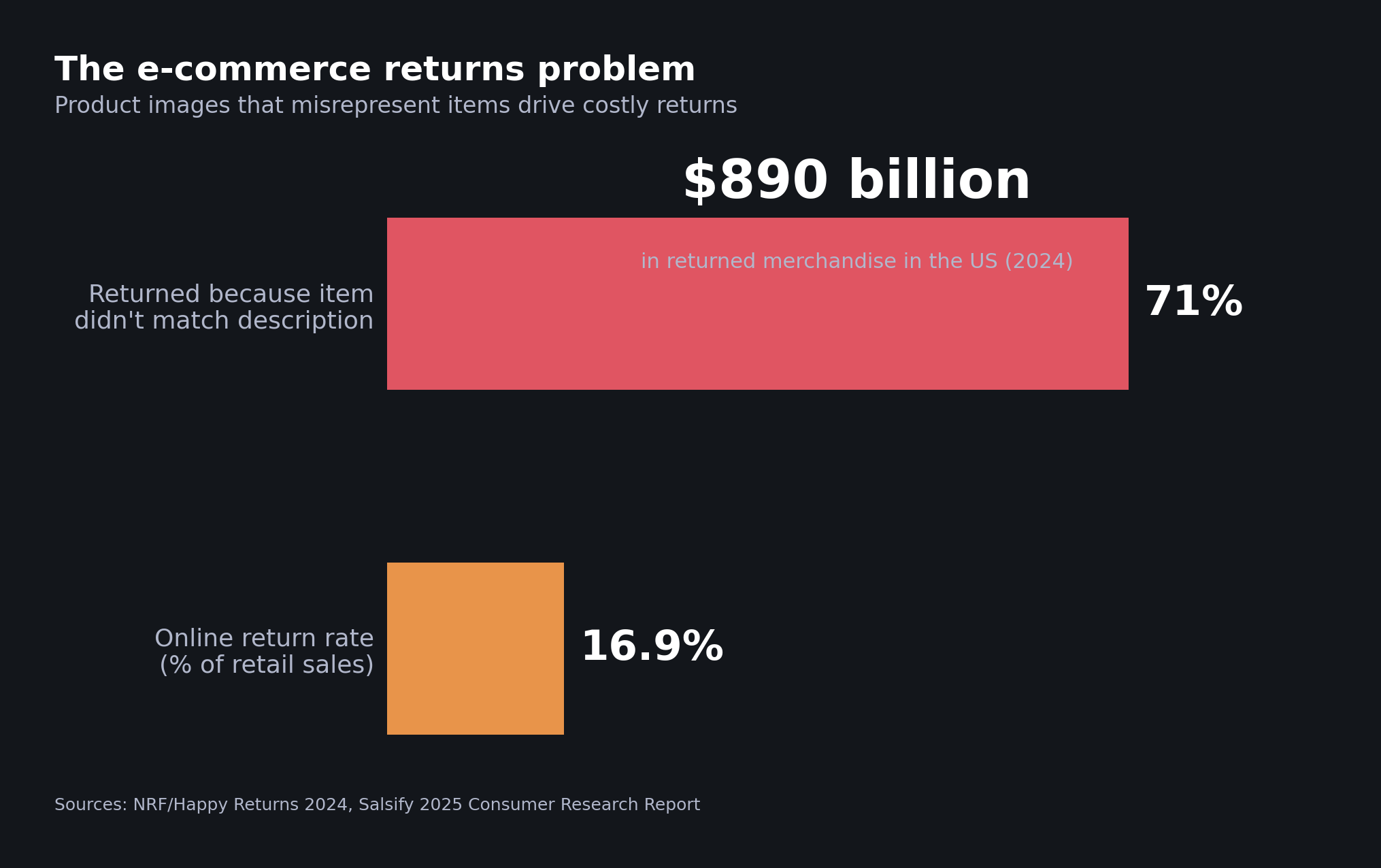
Returns are one of e-commerce's most expensive problems. According to the NRF/Happy Returns 2024 report, online return rates hit 16.9% of total retail sales in 2024, representing roughly $890 billion in returned merchandise in the US alone.
A significant portion of those returns trace back to mismatched expectations, and product images are a major driver. Salsify's data shows that 71% of consumers have returned products because the actual item didn't match the description. Wang, Li, Liu, Chau, and Chen (2024) developed a contrast-composition-distraction framework showing how product photo backgrounds affect consumer interest: shoppers prefer products on darker, simpler backgrounds, with the product centered and background blurred. While the study focuses on attention and interest rather than returns directly, the implication is clear: photos that fail to present the product cleanly lose shoppers before they even get to checkout.
The connection is straightforward. When your product images accurately represent the item, with true-to-life colors, sharp details, and sufficient views from multiple angles, buyers know what they're getting. When images are blurry, poorly lit, or misleading, returns spike.
Chrimes, Boardman, Vignali, and McCormick (2022) found this is especially true in fashion e-commerce, where the number and type of product images, along with zoom functionality, significantly affect how accurately consumers can judge clothing fit. Dang and Nichols (2023) showed that including size referents (objects that help gauge product scale) in user-generated photos helps consumers better evaluate products, making reviews more helpful and purchase decisions more confident.
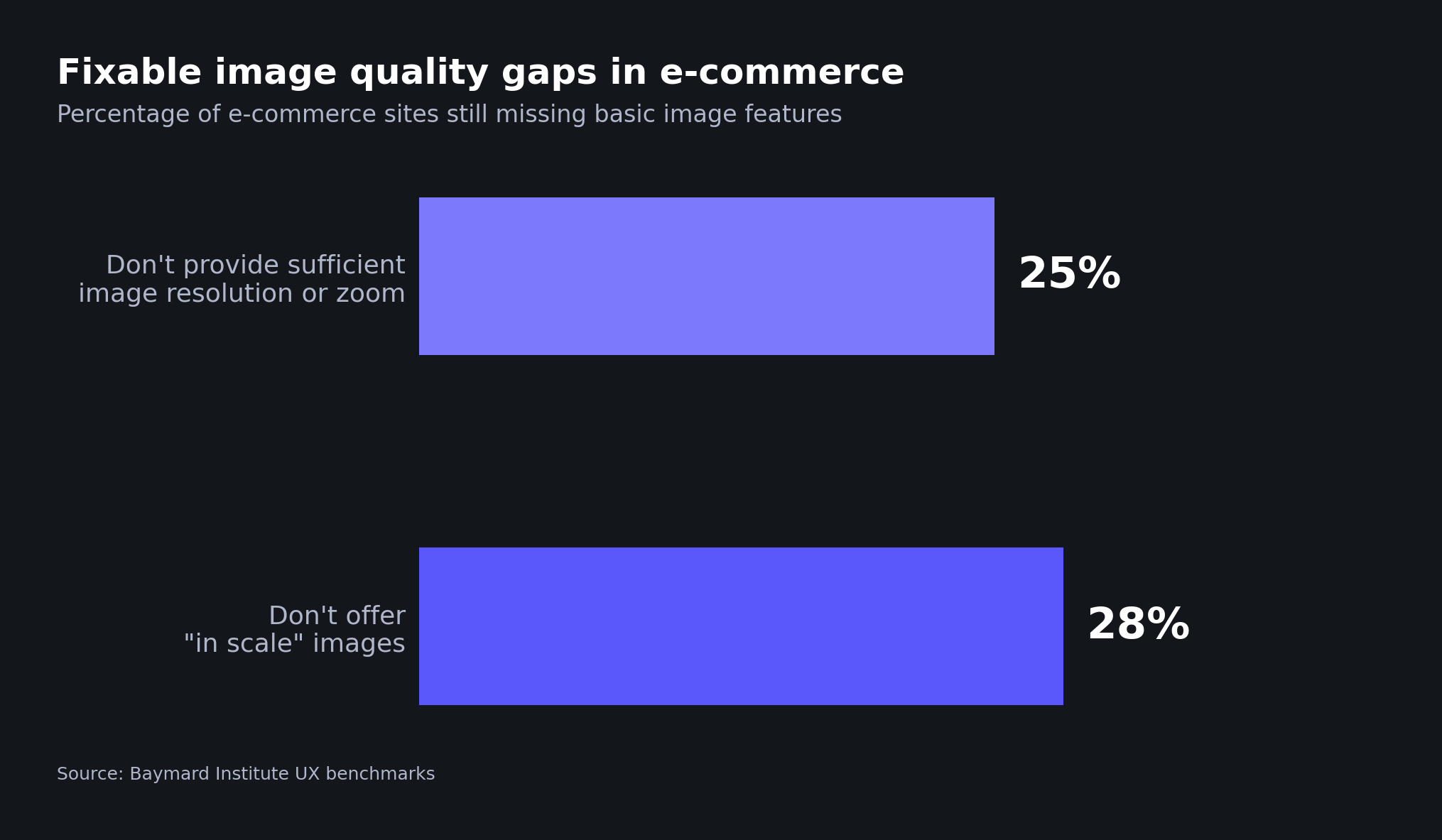
Baymard Institute's benchmarks put numbers on the opportunity: 25% of e-commerce sites still don't provide sufficient image resolution or zoom functionality, and 28% don't offer "in scale" images. These are fixable gaps that directly reduce returns.
Marketplace performance: the data from eBay
The relationship between image quality and sales is particularly measurable on marketplaces, where identical products compete side by side.
eBay's own data shows that listings with better photo quality are 4.5% more likely to sell, where "better" means at least 500 pixels on the longest side, no added text or graphics, and uploaded directly to eBay's picture service.
A separate study by Cornell Tech researchers dug into category-level differences: shoes with higher-quality images are 1.17x more likely to sell, and handbags 1.25x more likely. The researchers also found that shoppers trust sellers who post their own high-quality photos more than those who use stock images, even when the stock photos look polished.
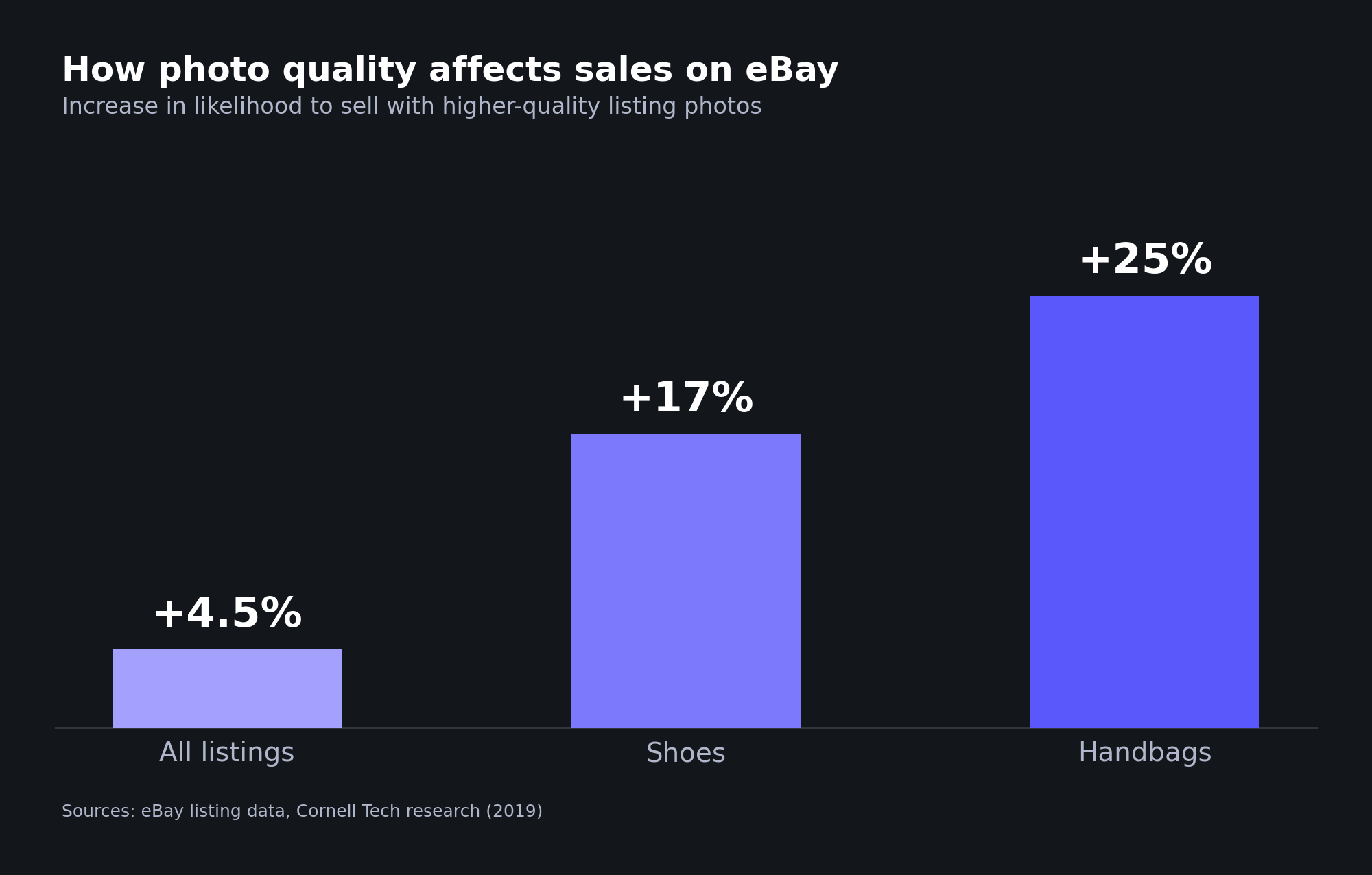
A 4.5% increase might sound modest in isolation. But across thousands of listings, it compounds. For a seller with 500 active listings, that's roughly 22 additional sales that would have been missed, simply because the photos were better.
Amazon's requirements tell a similar story from the platform side. Amazon requires main images to be at least 1,000 pixels (recommending 2,000 pixels for zoom functionality), with a pure white background filling 85% of the frame. Listings that don't meet these standards risk suppression from search results. Amazon's algorithm factors image quality into ranking, meaning lower-quality photos can push your listings down even if your price and reviews are competitive.
The mobile factor
More than half of e-commerce traffic now comes from mobile devices, where image quality matters even more. Small screens amplify the difference between a sharp, well-composed product photo and a mediocre one.
Patel, Das, Chatterjee, and Shukla (2020) studied mobile shopping app interface quality and found that visual appeal is one of four key dimensions that drive purchase intention, alongside information quality, product info quality, and layout. On mobile, poor image quality isn't just unappealing; it actively pushes shoppers away.
Orús, Gurrea, and Flavián (2017) found that richer visual content (including video) enhances "imagery fluency," the ease with which consumers can mentally picture themselves using the product. Higher imagery fluency increases product attitude and purchase intention. While video is one way to achieve this, high-resolution images with zoom capability serve a similar function, letting shoppers mentally "try" the product.
What this means for your product images
The research converges on a few practical points:
Resolution matters. Images need to be large enough to support zoom and look crisp on high-density screens. The minimum is 1,000 pixels, but 2,000+ is better. If your source images are too small, upscaling them can bring them to the resolution you need without introducing artifacts.
Clean backgrounds convert better. A simple, distraction-free backdrop keeps the focus on your product. For marketplace listings especially, a clean white background is often required and consistently outperforms cluttered alternatives. Background removal tools can help if your original photos weren't shot on white. You can consider Claid that's designed around e-commerce needs: beside just background removal, you can correct lighting, color, add background as well as generate new images with AI Photoshoot.
Sharpness builds trust. Blurry, noisy, or low-contrast images signal low effort and reduce perceived product value. If your photos were taken in poor lighting or with a phone camera, AI enhancement can recover detail and clarity that the original capture missed.
More views reduce returns. Multiple angles, zoom capability, and size reference images all help shoppers make confident decisions. The more accurately your images represent the product, the fewer returns you'll deal with.
Consistency across your catalog signals professionalism. When every listing has the same quality level, lighting style, and background treatment, it builds brand trust. Shoppers notice when some images look professional and others look like an afterthought.
The bottom line: product image quality isn't a nice-to-have. It's a direct lever on your most important e-commerce metrics, from click-through rate to conversion to return rate. The research is clear, and the tools to act on it are accessible.
Sources
Academic research
- Xia, H., Pan, X., Zhou, Y., & Zhang, Z.J. (2020). Creating the best first impression: Designing online product photos to increase sales. Decision Support Systems, 131. DOI: 10.1016/j.dss.2019.113235
- Szulc, R. & Musielak, K. (2022). Product photography in product attractiveness perception and e-commerce customer purchase decisions. Scientific Papers of Silesian University of Technology, Organization and Management Series, No. 166. DOI: 10.29119/1641-3466.2022.166.49
- Meng, L., Kou, S., Duan, S., & Jiang, Y. (2022). How a blurry background in product presentation influences product size perception. Psychology & Marketing, 39(8), 1633–1645. DOI: 10.1002/mar.21676
- Ert, E. & Fleischer, A. (2020). What do Airbnb hosts reveal by posting photographs online and how does it affect their perceived trustworthiness? Psychology & Marketing, 37(5), 630–640. DOI: 10.1002/mar.21297
- Hong, Y. & Pavlou, P.A. (2014). Product fit uncertainty in online markets: Nature, effects, and antecedents. Information Systems Research, 25(2), 328–344. DOI: 10.1287/isre.2014.0520
- Wang, M., Li, X., Liu, Y., Chau, P.Y.K., & Chen, Y. (2024). A contrast-composition-distraction framework to understand product photo background's impact on consumer interest in e-commerce. Decision Support Systems, 178. DOI: 10.1016/j.dss.2023.114124
- Chrimes, C., Boardman, R., Vignali, G., & McCormick, H. (2022). Investigating how online fashion product page design affects the consumer's clothing fit appraisal. Journal of Consumer Behaviour, 21(6), 1478–1493. DOI: 10.1002/cb.2100
- Dang, J. & Nichols, B.S. (2023). Effects of size referents in user-generated photos on product evaluation. Journal of Consumer Behaviour. DOI: 10.1002/cb.2281
- Patel, V., Das, K., Chatterjee, R., & Shukla, Y. (2020). Does the interface quality of mobile shopping apps affect purchase intention? Australasian Marketing Journal, 28(4), 300–309. DOI: 10.1016/j.ausmj.2020.08.004
- Orús, C., Gurrea, R., & Flavián, C. (2017). Facilitating imaginations through online product presentation videos. Electronic Commerce Research, 17(4), 661–700. DOI: 10.1007/s10660-016-9250-7
Industry reports and platform data
- Baymard Institute. Product page UX research and benchmarks. Product images as first action · In-scale images · Image resolution and zoom
- Salsify. (2025). 2025 Consumer Research Report. salsify.com/resources/report/2025-consumer-research
- NRF / Happy Returns. (2024). 2024 Consumer Returns in the Retail Industry. nrf.com/research/2024-consumer-returns-retail-industry
- eBay. Photo tips and listing optimization data. export.ebay.com/en/listings/how-optimize-your-listings/photo-tips
- Cornell Chronicle. (2019). Is seeing believing? Image quality and trust in peer-to-peer marketplaces. news.cornell.edu
