
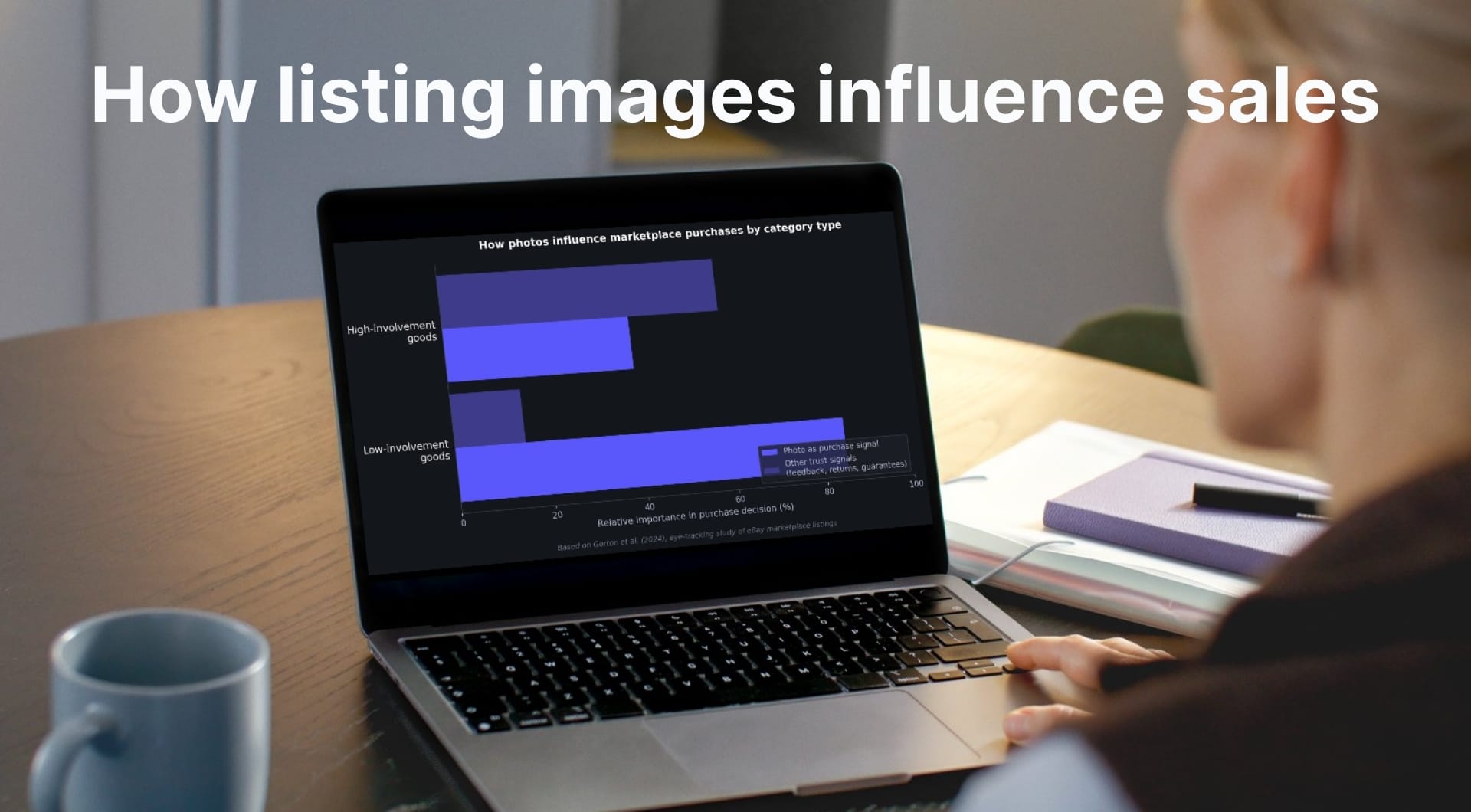
On a marketplace, your listing photo is your storefront. There's no brand reputation to fall back on, no curated website experience. A buyer scrolling through dozens of identical listings makes a snap judgment based on one thing: how your photos look.
This dynamic is fundamentally different from traditional e-commerce, where a brand's reputation and website design do some of the trust-building work. (We covered that broader picture in our research review of product image quality and e-commerce performance.) On marketplaces and classifieds, the photo carries more weight because the seller is often unknown. The listing image is the primary trust signal.
Here's what academic research and platform data tell us about exactly how much that matters.
On marketplaces, your own photos beat stock images
One of the clearest findings in marketplace research is that buyers trust sellers who post their own photos more than those who use stock images, even when the stock photos look more polished.
Johnson, Vang, and Van Der Heide (2015) studied 217 completed eBay auctions and found that listings with actual product photographs (as opposed to manufacturer stock images) attracted more bidders and sold at higher prices. The researchers applied warranting theory: signals that are harder to fake carry more weight with buyers. A stock photo tells the buyer nothing about the specific item's condition. A real photo, even a slightly imperfect one, proves the seller actually has the product and is willing to show it.
Ma et al. (2019), in a study spanning Letgo and eBay with roughly 75,000 images, confirmed this pattern at scale. Their image quality model achieved about 87% accuracy in predicting listing outcomes, and high-quality user-generated images outperformed stock imagery specifically in building buyer trust. The caveat: image quality was one factor among several, with view count being a stronger predictor of whether an item actually sold. But among the factors sellers can control, photo quality stood out.
The practical takeaway is counterintuitive for sellers coming from traditional e-commerce. On a marketplace, a clear, well-lit photo of your actual item builds more trust than a polished manufacturer image. The photo needs to prove you have the thing.
Photo quality operates differently depending on what you're selling
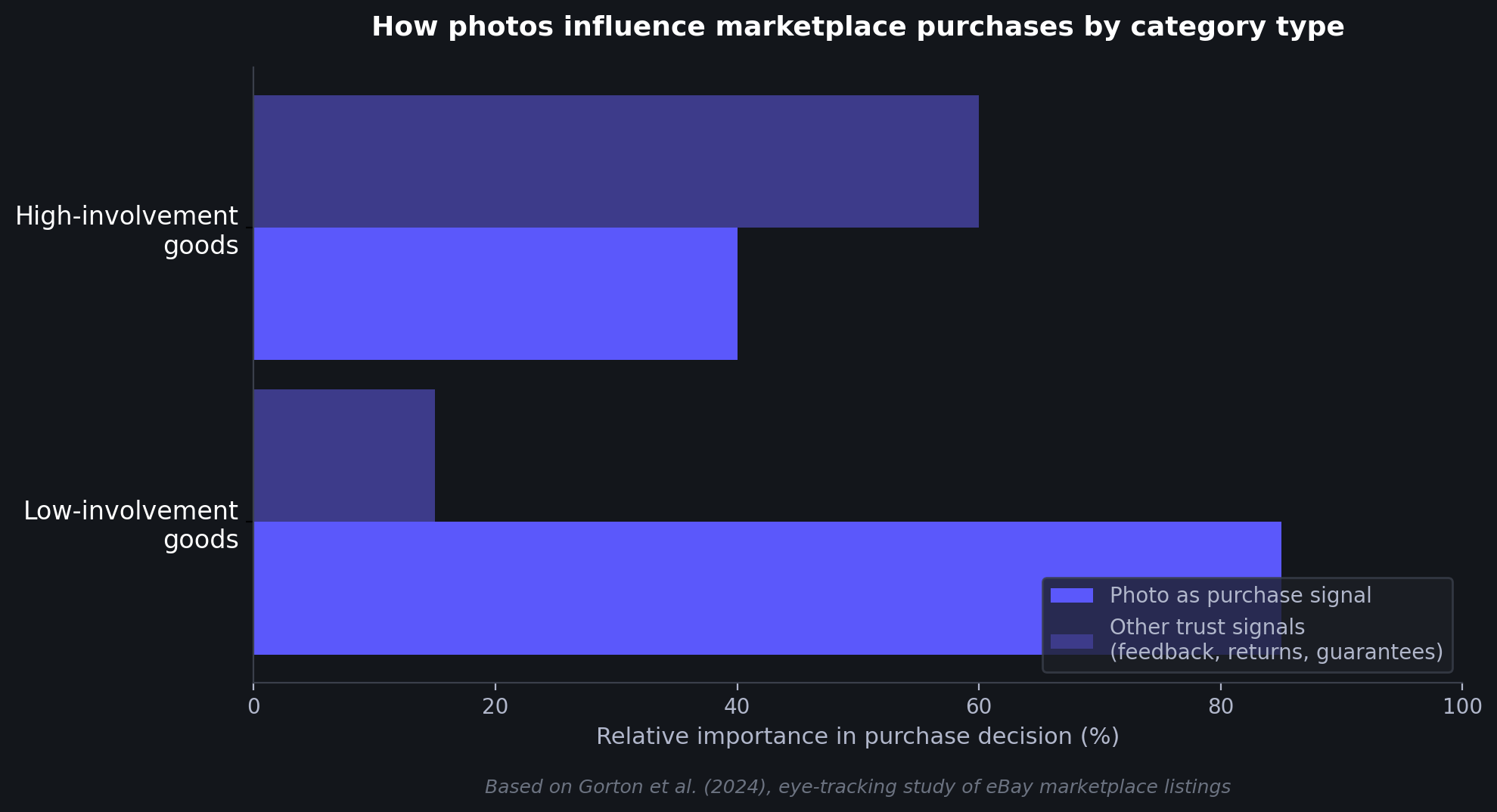
Not all marketplace categories respond to listing photos the same way. Gorton et al. (2024) used eye tracking and interviews to study how eBay shoppers process listings for different product types.
For low-involvement purchases (a phone case, a set of kitchen utensils), buyers relied on what the researchers called "fast and frugal" signals: price plus photos. They spent minimal time evaluating these listings. A clean, clear product photo was often enough to trigger a purchase decision.
For high-involvement goods (electronics, designer items), photos alone weren't sufficient. Buyers sought additional trust signals beyond the seller's direct control: seller feedback scores, return policies, platform guarantees. The photo still mattered, but it was the entry ticket, not the closer.
This has real implications for how you invest time in listing photos. For lower-priced items, the photo is often the entire sales pitch. For expensive items, the photo gets the buyer to stop scrolling, but the description, seller history, and platform protections close the deal.
The eBay data: category-level differences
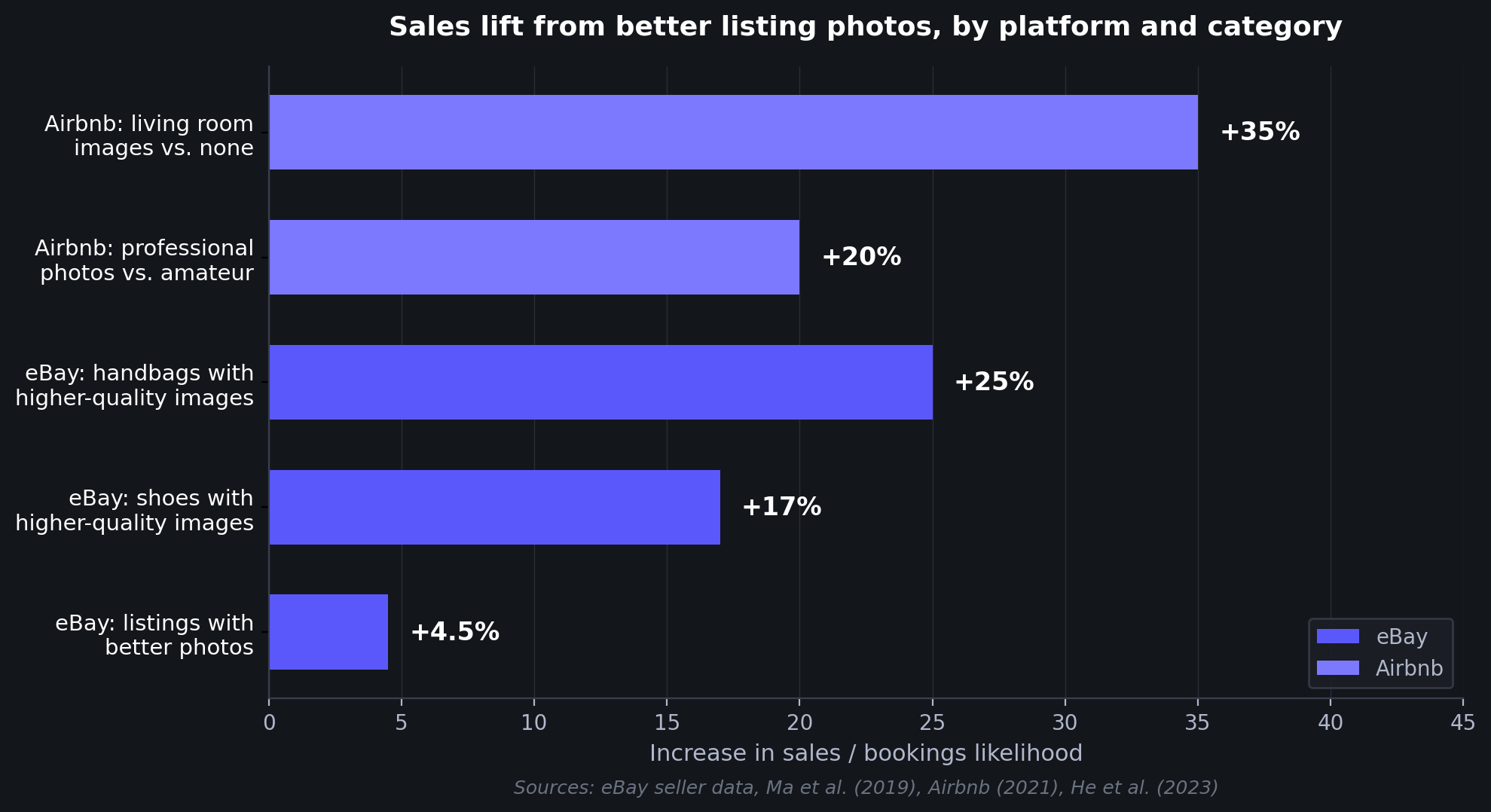
eBay provides some of the most concrete marketplace-specific data. According to eBay's own seller guidance, listings that follow their photo quality standards (at least 500 pixels on the longest side, no added text or graphics, uploaded directly to eBay's picture service) are 4.5% more likely to sell.
Ma et al. (2019) broke this down by category in their analysis of Letgo and eBay data. Shoes with higher-quality images were 1.17x more likely to sell. Handbags were 1.25x more likely. These category differences make intuitive sense: for items where visual details indicate condition and authenticity (stitching, material texture, brand markings), photo quality matters more.
eBay also bans stock photos as the primary image for pre-owned items. This policy reflects the same insight the academic research confirms: for secondhand goods, buyers need to see the actual item. A manufacturer photo of a "like new" handbag tells the buyer nothing about scuffs, wear, or discoloration.
Airbnb: where photo quality has been quantified most precisely
Marketplace photo dynamics extend beyond physical products. Airbnb, essentially a marketplace for short-term rentals, has produced some of the strongest evidence on how listing images affect demand.
He, Li, and Wang (2023) studied Airbnb listings across New York City and San Francisco and found that what photos show matters more than how they look technically. Living room images increased bookings by 35% (roughly $728 in additional revenue during the study period). Bedroom-focused images, surprisingly, actually decreased bookings. Interior design elements visible in backgrounds also boosted demand. The researchers controlled for endogeneity using propensity scores and instrumental variables.
The finding that content trumps aesthetics is striking. Sharp focus and good lighting help, but showing the right things in your photos has a larger effect than making them technically perfect.
Li, Simchi-Levi, Wu, and Zhu (2023), published in Management Science, confirmed that the cover photo (the first image a potential guest sees) has a significantly larger impact on demand than any other photo in the listing. Their structural model showed that optimizing which photo appears first can meaningfully increase bookings without changing the listing itself.
Airbnb's own data from an analysis of 5,000 global listings showed that hosts with professional photos earn up to 20% more and receive 20% more bookings compared to hosts without them. Airbnb invested in a professional photography program specifically because of this return.
While these Airbnb findings don't transfer directly to product marketplaces, the underlying principle applies: on any listing platform, the first photo is the single biggest driver of whether someone clicks through.
The secondhand and resale boom makes photo quality higher-stakes
The marketplace where listing photos matter most is also the marketplace growing fastest: online resale.
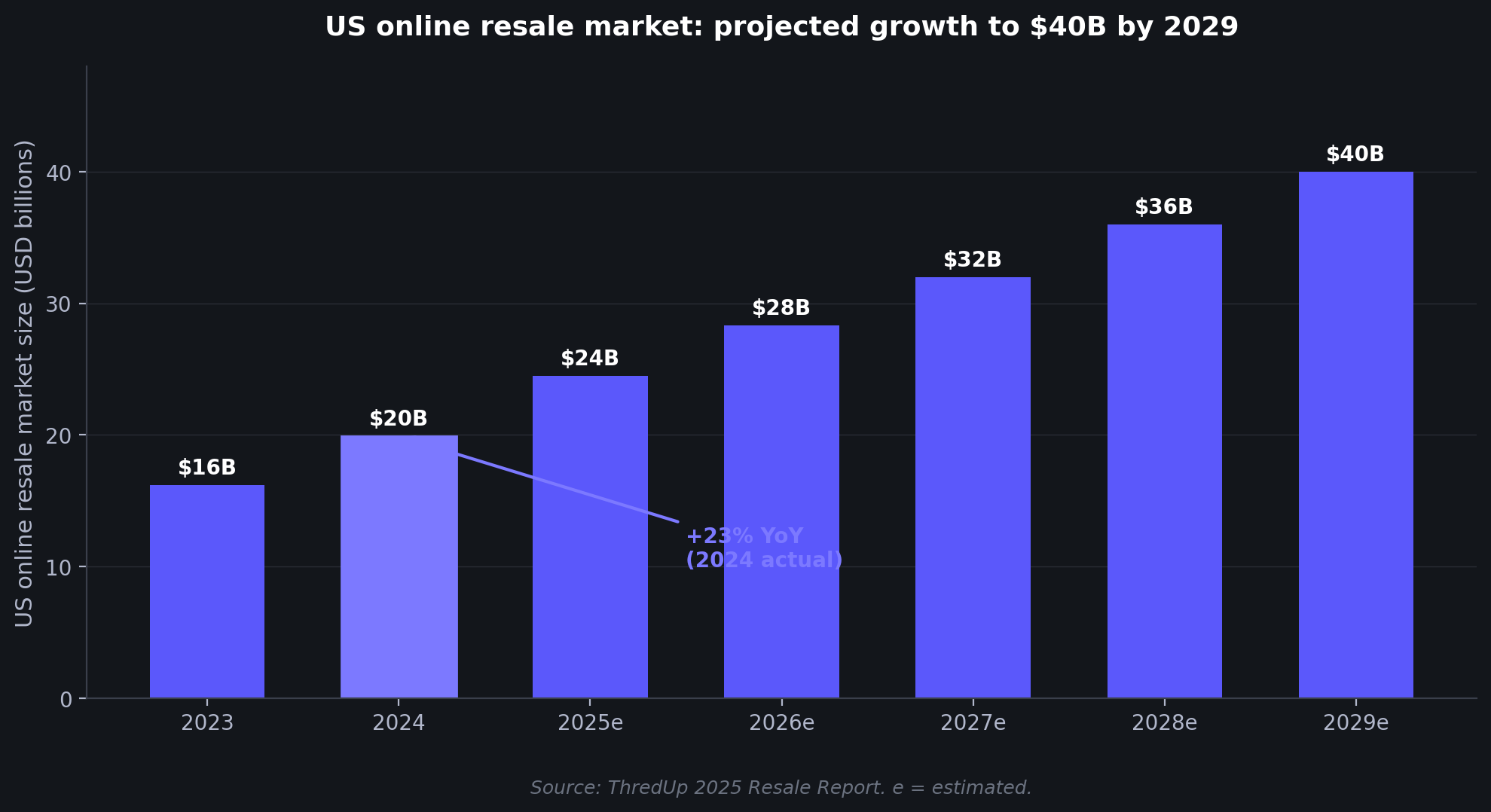
ThredUp's 2025 Resale Report shows the US secondhand apparel market grew 14% in 2024, with online resale specifically growing 23%. The report projects online resale will reach $40 billion by 2029. In 2024, 58% of US consumers shopped secondhand.
This growth is spread across platforms. Vinted now has over 75 million registered members across 18 countries, with revenue of €813.4 million in 2024 (up 36% year over year). Depop has over 35 million users and $788 million in gross merchandise value.
For secondhand sellers, photo quality serves a function it doesn't serve in new-product retail: condition assessment. A buyer considering a used jacket needs to see the fabric texture, any pilling or wear, the zipper condition, the tag. No amount of description can substitute for a photo that shows these details clearly.
Pandey, Mittal, and Chawla (2024) studied this dynamic in luxury resale specifically. Surveying 313 consumers, they found that perceived product certainty was the strongest driver of purchase intention for secondhand luxury goods. Visual quality (website aesthetics, clear product presentation) was one of the key signals that reduced buyer uncertainty. When buyers can't physically inspect a pre-owned item, the listing's visual presentation becomes the primary tool for assessing authenticity and condition.
Platforms are betting on photo quality with AI tools
The biggest marketplace platforms aren't just recommending better photos. They're building AI tools to make better photos the default.
Depop partnered with Photoroom to integrate AI photo editing directly into its listing flow. Sellers can remove backgrounds and enhance images without leaving the app. The investment signals how strongly Depop believes photo quality drives sales on its platform.
Poshmark launched Smart List in January 2025, an AI feature that uses listing photos to auto-populate titles, descriptions, categories, and brand information. The listing photo became the input for the entire listing, not just the visual.
Etsy allows up to 10 photos per listing and uses the first image as the search thumbnail. With 46% of Etsy sales happening through mobile, where screen space is limited, that thumbnail image determines whether a listing gets a tap.
These platform investments confirm what the research shows: listing photo quality isn't a nice-to-have on marketplaces. It's the primary signal that determines whether your listing gets seen, clicked, and trusted.
What this means for marketplace image signals
The research also suggests subtler effects. Zakrewsky, Aryafar, and Shokoufandeh (2016) analyzed Etsy listings and found that combining image features (color, simplicity, composition, texture, aesthetics) with text data outperformed text-only models in predicting which listings would become popular, as measured by search clicks, favoriting, and purchases. Image quality feeds directly into platform algorithms that determine listing visibility.
This creates a feedback loop: better photos get more visibility, which generates more views, which leads to more sales, which improves seller reputation, which further boosts visibility. The compound effect means that photo quality improvements have outsized returns over time.
What to do about it
The practical applications vary by what you're selling and where, but a few principles hold across platforms:
Shoot the actual item. On marketplaces, your own photos build more trust than stock images, especially for pre-owned goods. Show condition honestly: buyers who know what they're getting don't send returns.
Lead with your strongest photo. The cover image drives more engagement than all other photos combined. For product listings, this means a clean, well-lit front view. For Airbnb-style listings, it means showing the space that matters most to guests.
Match your effort to the category. For a $10 accessory, a clean phone photo on a white surface is sufficient. For a $500 handbag, invest in multiple angles, close-ups of hardware and stitching, and shots that show scale.
Meet platform standards. eBay requires minimum 500 pixels and bans stock photos for pre-owned items. Etsy recommends natural light and uses your first photo as the search thumbnail. Each platform has specific requirements that affect visibility.
Fix quality issues after the fact. If your source photos are too small for marketplace requirements, upscaling can bring them to the resolution platforms need. Noisy or poorly lit shots can be improved with AI enhancement. And if you're shooting on a kitchen table, background removal can give your listing a clean, professional look that competes with sellers who have studio setups.
The bottom line: on marketplaces, your listing photo isn't just a picture of your product. It's your reputation, your storefront, and your trust signal, all compressed into a single image. The research consistently shows that improving it is one of the highest-return investments a seller can make.
Sources
Academic research
- Ma, X., Mezghani, L., Wilber, K., Hong, H., Piramuthu, R., Naaman, M., & Belongie, S.J. (2019). Understanding image quality and trust in peer-to-peer marketplaces. IEEE Winter Conference on Applications of Computer Vision (WACV), pp. 511-520. DOI: 10.1109/WACV.2019.00060
- Johnson, B.K., Vang, M.H., & Van Der Heide, B. (2015). Show me the goods: The warranting effect of user-generated photographs in online auctions. Journal of Media Psychology, 27(1), 3-10. DOI: 10.1027/1864-1105/a000126
- Gorton, M., Marek-Andrzejewska, E., Pang, G., Andrzejewski, W., & Lin, Y. (2024). Users' processing of online marketplace listings for high and low involvement goods. Electronic Commerce Research and Applications, article 101382. DOI: 10.1016/j.elerap.2024.101382
- Li, H., Simchi-Levi, D., Wu, M.X., & Zhu, W. (2023). Estimating and exploiting the impact of photo layout: A structural approach. Management Science, 69(9), 5209-5233. DOI: 10.1287/mnsc.2022.4616
- He, J., Li, B., & Wang, X.S. (2023). Image features and demand in the sharing economy: A study of Airbnb. International Journal of Research in Marketing, 40(4), 760-780. DOI: 10.1016/j.ijresmar.2023.04.001
- Zakrewsky, S., Aryafar, K., & Shokoufandeh, A. (2016). Item popularity prediction in e-commerce using image quality feature vectors. arXiv preprint, arXiv:1605.03663. arxiv.org/abs/1605.03663
- Pandey, S., Mittal, S., & Chawla, D. (2024). Tackling consumer information asymmetry and perceived uncertainty for luxury re-commerce through seller signals. Journal of Retailing and Consumer Services, 79, article 103736. DOI: 10.1016/j.jretconser.2024.103736
Industry reports and platform data
- Airbnb. (2021). Professional photography program and listing performance data. airbnb.com/e/pro-photography
- eBay. Photo tips and listing optimization data. export.ebay.com/en/listings/how-optimize-your-listings/photo-tips
- ThredUp. (2025). 2025 Resale Report. thredup.com/resale
- Depop / Photoroom. AI photo editing integration. news.depop.com/company-news/depop-partners-with-photoroom...
- Poshmark. (2025). Smart List AI listing feature. poshmark.com
- Etsy. Seller handbook and listing image guidelines. etsy.com/seller-handbook
- Vinted. Platform statistics and press data. vinted.com
